As for the visibility of the planets, my reference remains "Ardua et Astra: On the Calculation of the Dates of the Rising and Setting of Stars' by Matthew Robinson from University College London
https://www.journals.uchicago.edu/doi/10.1086/650145
Petr9 has developed many visibility aspects in Astro-Seek for Venus, Mercury and Mars. Under Planetary Cycles.
As Martin mentioned, we would need a tool for all planets with dates and times.
Alcyone provides the 'Apparent Morning Rising' (first visibility) and 'Apparent Evening Setting' (last visibility).
The cosmical rising and setting can be approached on the website In-The-Sky.org by looking at the Altitude of the planets but I am not sure if the ancient literature considered these factors as their approach was centered on the 'visibility' of the planets. That remains a grey area for me right now.
Resume of Matthew Robinson article and the terminology.
Page 3
"The ‘true’ risings and settings take place when the star crosses the horizon at the same time as the sun: as the sky is still bright at this time, these phenomena cannot be observed and the dates can only be reached by calculation. The ‘apparent’ risings and settings take place just before sunrise or just after sunset, when the sky is just dark enough for the star to be visible. Since the ‘apparent’ phenomena are the only ones which can actually be seen, it seems clear that they are the phenomena referred to in the majority of literary texts and parapegmata; references to the ‘true’ phenomena, which cannot be seen and whose dates cannot be ascertained without mathematical or mechanical assistance, are obviously of less practical use and tend to be confined to ancient handbooks on astronomy."
True Morning Rising (TMR) (true) cosmical rising
the star crosses the eastern horizon with the sun: for the previous few days it had crossed the eastern horizon after sunrise (and was thus invisible); on the day of the true morning rising, it was below the horizon shortly before sunrise (and thus was invisible), and will remain invisible as it crosses the horizon (as the day has now dawned and the sun’s light obscures that of the star).
Apparent Morning Rising (AMR) heliacal rising
‘first visibility’
the star crosses the eastern horizon shortly before the sun, and is thus briefly visible (for the first time). With every morning that follows, the interval between the star’s rising and sunrise increases: the star is visible earlier, and for longer. This is the first of many visible risings.
True Morning Setting (TMS) (true) cosmical setting
the star crosses the western horizon as the sun crosses the eastern horizon: for the previous few days, the sun had risen before the star had set, and so as day dawned the star could be seen some distance above the western horizon.. On the day of the true morning setting, the star was visible before sunrise, but its setting is obscured by the light of the rising sun.
Apparent Morning Setting (AMS) (
visible) cosmical setting
the star crosses the western horizon just before the sunrise, and so can be seen to set (for the first time) in the morning twilight. With every morning that follows, the interval between the star’s setting and the sunrise increases: this is the first of many visible settings.
Apparent Evening Rising (AER) (
visible) acronychal rising
The star crosses the eastern horizon just after sunset. On previous days the star had crossed the horizon some time after sunset, and so its rising was easily visible. On subsequent days the interval between sunset and the star’s rising diminishes, and the sky is too bright for the star’s rising to be seen, and by the time the sky is dark the star is already some distance above the eastern horizon. Thus the apparent evening rising is the last visible rising of the star after sunset.
True Evening Rising (TER) (true) acronychal rising
the star crosses the eastern horizon as the sun crosses the western horizon, and is thus is invisible. By the time the sky is dark enough for the star to be seen, it will have already risen and be some distance above the eastern horizon.
Apparent Evening Setting (AES) heliacal setting
‘last visibility’
The star crosses the western horizon shortly after sunset. On previous days the star crosses the western horizon some time after sunset, and so it could be seen for some time in the night sky and it setting was easily visible. This is the last visible setting of the star, as on subsequent days the star will have disappeared under the horizon by the time the sky is dark, and so will be invisible.
True Evening Setting (TES) (true) acronychal setting
The star crosses the western horizon with the sun: by the time the sky is dark enough for stars to be seen, the star is beneath the horizon and so is invisible.
-----------------------------
On a side note, Sky & Telescope offers an
interactive sky chart for your location.
The map includes the Moon, stars brighter than magnitude 5, the five bright planets (Mercury, Venus, Mars, Jupiter, and Saturn), and deep-sky objects that can be seen without the use of optical aid.
Change the horizon view by dragging the green square on the full-sky chart.
Customize your map to show (or not show) constellation lines, names, and boundaries, deep-sky objects, star and planet names, and more. They offer the option to turn off the Sun, in order to show which stars are up during the daytime.
https://skyandtelescope.org/observing/i ... sky-chart/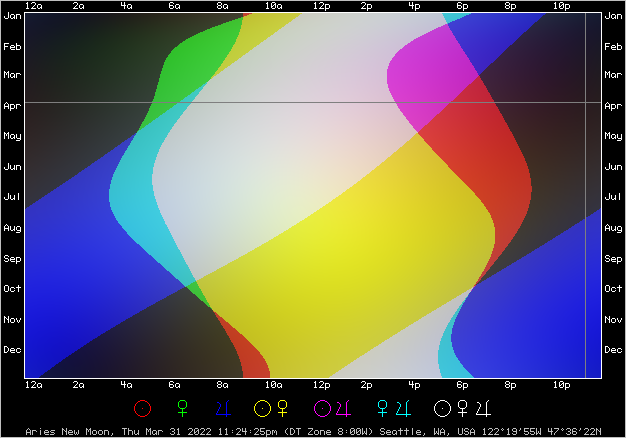
 You can include multiple bodies in Astrolog's visibility graph, for example the above shows at a glance that the only times you can see both Jupiter and Venus at the same time (i.e. when both Jupiter and Venus are above the horizon, and when the Sun is below the horizon) are in the early morning hours between May and October, and also the early evening hours in December.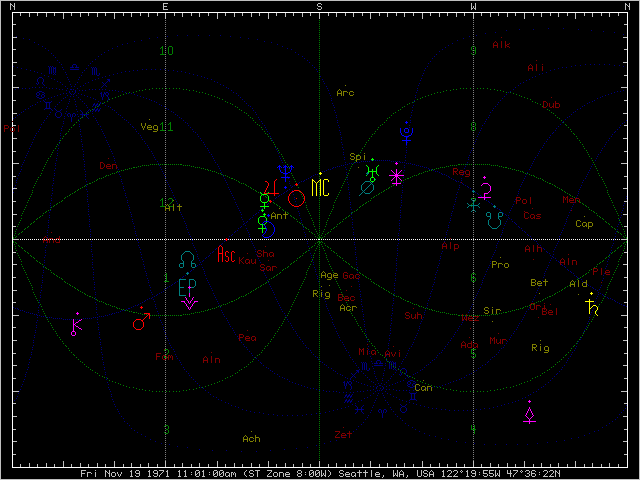
 I confess I find the multicolour graph unintelligible (it doesn't communicate anything at all to me 'in a glance', whereas a text table does). It reminds me of the sort of abstract art often found in public venues.
