MarkC wrote:
It does seem that western sidereal astrologers like Cyril Fagan have been quite influential on modern astroogy in this area. Does any traditional literature talk about exclusively planetary parans?
This thing sounds - but don't know anything about Fagan and these planetary parans - as mundane aspects. And Martin Ganstein too put paranatellonta and mundane aspects together at page 89-90 of his book.
This is obvious for me, because paranatellonta and mundane aspects (as stars in cieloeterra teaching) are taken by the motion of the
primum mobile.
A paranatellonta star is in fact a star which rises (ie with its oblique ascension) with whatever degree of Zodiac or culminates (with its right ascension).
Now, mundane aspects are aspects taken by the same motion of the sphere.
When a planet is rising at the Ascendant and another is culminating they could not be in a square by longitude, but surely they are in exactly square by the motion of the sphere.
This is what Steve calls a paran- I call a mundane square.
As Martin explains very well in his book, in mundo aspects come mostly from Placido - by his reading of Ptolemy (I quote from Martin book)
"And sometimes also among the signs that ascend slowly in the sextile aspect destroys when it is afflicted, and again among the signs that ascend rapidly the trine".
I am keen to follow up this definition offered by Martin.This is very similar to how Robert Schmidt interprets the term. I accept there are classical sources like Anonymous of 379 that consider stars and planets as astrologically connected on different angles. However, would it be reasonable to state that this is a different technique from the normal Greek use of the term paranatellonta?
I'm not familiar with Schmidt interpretation of the word, but for me stars traditionally can be at different angles (BUT JUST AT THE VERY MOMENT OF THE BIRTH, not during the day).
An example of this is the famous
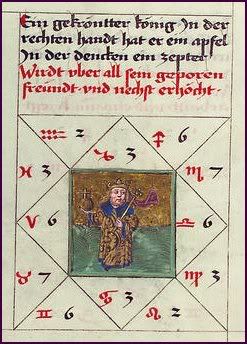
Astrolabium Planum (which can be downloaded in my blog - it was translated in English by Gadbury).
In Astrolabium Planum - the original text was written around 1300 by Pietro Abano- the small sentences for every degree are based on several stellar catalogues- especially the pages from Albumasar liber VI, which in turn were based on Teucer list of stars
sphera barbarica (I'm cutting short a very long story here).
But the stars linked with each degree can be indifferently to one of the four angles.
The same does Manilius when mentions between paranatellonta of Aries, Argo Navis which does not rises with Aries, she culminates when Aries rises.
According Simonetta Feraboli - for me the greatest expert of stellar catalogs, it was Franz Boll in Sphaera (1903) who showed how angles were linked in stellar catalogues.
So it's evident in all the variants of Anonymous 379/Liber de stellis beibenie (here I'm taking from Dr. Dykes' Liber Aristotles): for example Spica, Vega, Fomalhaut rising with Mars at the Descendant makes a refined natural philosopher, here this is case of paranatellonta in my opinion.
But because the native is born with that configuration, not 2 hours after, at midday, in the evening, those cases I call a transiting mundane aspect (if something like that can exist, I don't know)
margherita