Pierre wrote about Woman #2:
Physical weakness, lazy body, very little muscle tone and strength, things feel always heavy etc. She hates sport.
[She] is physically quite weak, dislikes sport, she feels that every object she carries is heavy (Jupiter does this). Once at the beach in a group activity, it was impossible to make her swim, which other kids did with abandon.
The Deb Jupiter rising in tropical becomes Jupiter well placed in Sag rising in Sidereal, which should be really nice for health.
In tropical the ruler of the DEB Jupiter was Saturn which was DEB also in Aries.
In Sidereal Jupiter does not have a ruler influencing it...
The chart of Woman #2 is an example of why the ascendant degree is so important when analyzing a chart. When this chart is set up in the Raman-Vehlow equal house system (equal cusps at the center of 30 degree houses), one angular configuration jumps out at us: Saturn-Ketu at the nadir squaring the ascendent. Ketu is the nakshatra lord of the ascendant, so the Saturn conjunction is very important.
It?s true that Jupiter, the ascendant lord, is in its own sign in Sagittarius and even receives the benefit of a trine from 5th lord Mars in Leo. But, Jupiter is placed exactly on the sandhi point between the 1st and 2nd house, 15 degrees from the ascendant, so is devoid of expression. This is like being locked in solitary confinement with no chance of escape. (Since Jupiter disposits itself, no other planet releases it from prison.) Additionally in the navamsa chart Jupiter is in the 6th in Scorpio, and goes to the natal 12th house sign.
The prominence of Ketu-Saturn brought to mind my previous study of temperament charts from Dorian Gieseler Greenbaum?s
Temperament: Astrology?s Forgotten Key. This woman?s chart resembles the Phlegmatic charts in the book. Traits of this temperament include inertia, slowness, and lack of energy. Here are some examples from the book:
Kevin: Moon/Ketu (in Saturn ruled Capricorn) near 4th cusp squaring the ascendant.
Diedre: Saturn on cusp 4 square ascendant (Uranus/Mars conjunct Saturn)
Ketu rising above the ascendant.
James: Saturn conjunct Mars sextile Sun on cusp 7. (Sun is ascendant lord.)
Navamsa Ketu with the Moon in Capricorn.
Gretchen: Ketu/Mercury on cusp 4 square ascendant. (Mercury is ascendant lord.)
So we see that two culprits related to the slow, lacking-in-energy Phlegmatic temperament are Ketu and Saturn. This configuration is the key to the chart of Woman #2. Prash Trivedi in
The Key of Life says of this conjunction:
?This can be seen as the toughest of all two planet combinations. It suggests deeply ingrained Saturn habits carried over from past lives. This can be a hard thing to deal with in the present life as one tends to be innately pessimistic...
?When Ketu is neutralizing the bad karma from previous lives, this combination can be a very limiting constrictive influence...? (p. 177)
Taking the karmic view of this Ketu-Saturn configuration, the result can be the medical problems Pierre mentioned in his initial post. (As I have no medical training myself, I don?t discuss medical specifics in astrological terms.)
But the sidereal chart clearly shows the weakness of Jupiter as ascendant lord, and the prominence of Saturn-Ketu using a house system commonly used in India, ?Indian Equal House.? This is sometimes called the Raman house system as Raman discusses it in his
Manual of Hindu Astrology as the most accurate house system from his own research of 30 years. (page 96)
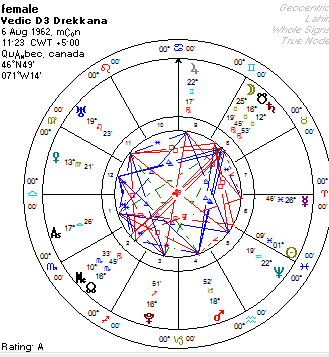 As Saturn and Moon are in the 8th house in the Drekkana, it's automatically in the 22nd Drekkana. (The 8th house of drekkana chart is always equal with that.)

