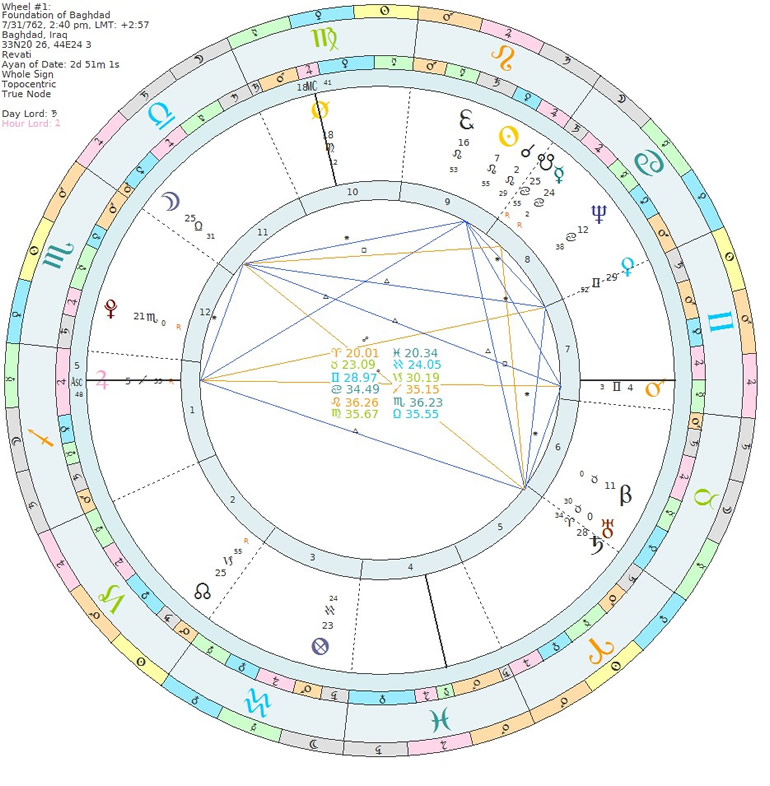
I'm posting three versions of the chart.
The first - the one I think is the most instructive of what the astrologers involved considered - is a hand drawn chart based on the historically reported positions; the sources being Al Biruni's
Chronology, (pp.262-3), the details given of Ibn al-Faqih's version in
Allawi's paper, pp.63-63), and Pingree's report of the position of Saturn (?The Fragments of the Works of Al-Faz?r??, Journal of Near Eastern Studies, Vol. 29, No. 2 1970; p.104).
Note the comments I made earlier about Allawi giving incorrect details about the chart presented by Al Biruni, (in his table on p.65). However, on p.63, Allawi's paper shows a graphic of the untranslated chart as it appears in Al Biruni's manuscript. Although most of this is meaningless to me, I can see that it records the position of a planet in Aries - obviously the source for Pingree's record that Saturn should be at 26.40 Aries. Sachau's English translation of the chart doesn't show any position for Saturn, and the corresponding area of this chart is empty, so it seems pretty clear that it was omitted by mistake.
Modern charts show Jupiter and Mercury as retrograde, but the historical reports don't mention this. Both were stationing and turning direct, so I presume the astrologers of the time would have considered them to be in this notable state rather than retrograde. Other than those SD notations (in red) this chart only shows information given in historical reports.
This chart makes a lot more sense to me astrologically than any modern chart based on computer recalculation. The most important electional principle for the foundation of a city is to have the Moon well placed and witnessed by all the other planets (a planet without aspect to the Moon indicates a lack of resources according to that planet's signification (Hephaistio, III.7 - and thanks to Ben Dykes for drawing that comment to my attention when he was working on the text). The astrologers would not want the Moon at the end of its sign, voc or about to enter its sign of fall. At this position the Moon's next aspect is the square to the MC-ruler Mercury, which is stationary and powerfully placed on the nodes, in the Moon's own sign so the Moon is able to commit its dispostion to it. Allawi has pointed out (p.65 and 69) how "the newborn Moon is in maximum latitude, almost perpendicular to the line of the lunar nodes" and how this was built into architectural design, with symbols of "two dragons which menace the new-born child symbol of the new Moon" - his suggestion is that they represent "that the new born moon has mastered the two dragons".
I have also noticed important correspondences with other relevant historical charts - for example, the Moon in this chart corresponds with the midheaven in the accession chart of its founder Al Mansur, which also has a Jupiter-Venus conjunction (at 7-8? Aries), connecting to the Jupiter-Sun trine of this chart (so creating a grand tine between the two charts). One of the points often missed in the discussion of this chart, is that it would not have been cast without taking into account the important themes of other charts. We know, for example, that Libra was an important sign for the Abbassid caliphs, because Masha'allah recorded it as the ascending sign of the prophet Muhammad (Allawi p.64).
Below is the closest computer generated match, based on the sidereal zodiac and the revati ayanamsha, (I created this by following Therese's recommendation to add 3?53 to the Krishnamurti ayanamsha). The correspondence of the positions is closer than anything I've seen published elsewhere. Allowing for rounded calculations, less exact latitude and longitude, and the possibility of small errors in the tables, it shows that the astrologers were not nearly as erroneous as we sometimes assume them to be. (In my opinion, the astrologers who worked on this chart were masters of their craft, so if there are mistakes, it is probably down to copyist errors or limitations of our understanding rather than theirs.)

Incidentally, I have shown the chart as calculated by Alchabitius semi-arc houses. We know that Masha'allah used a combination of whole sign and some kind of quadrant system (what he referred to as "by counting" or "by division"). I don't know what he used for "division" but there is very little difference between the cusps generated by the Porphyry or Achabitius semi-arc system, the two most likely candidates. We don't know what, if anything was made of the house positions in this chart, but I figured its easy enough for astrologers who follow the whole sign system to just look at the signs, to note what he might have judged "by counting", so added the quadrant houses for an extra convenience.
Below is the chart cast for the same time according to the tropical zodiac:
I've never liked the position of Saturn in this chart, and it always struck me as odd that astrologers make a lot about the placement of Mars, but don't question the fact that the Moon is at the end of its sign and about to make an out of sign opposition to Saturn which completes as the Moon moves into its sign of fall. This thread has been very informative for me in many ways and I've now obviously reverted from my previous opinion that the tropical zodiac makes the best fit with the historical reports. Clearly, the revati chart has less computational difference. Although there's not a lot of disagreement between the two charts, I've got a lot out of being able to verify the sign position of Saturn - at least to my own satisfaction at this time (I'm still open to revising if new information comes to light!).
I have a couple of quick posts to make in the forum, then I'm likely to be offline for a few days - so best wishes to all for a great 2014!


 ).
).