Hi Deb,
You said:
"Without checking the actual words I used, I would hope that the full context of my presentation makes clears what my argument is about: the lack of recommendation of signs for houses as a preferred technique in ancient and historical texts (as opposed to a convenient approach adopted when precision is unnecessary or time is unknown).
I am not unaware of examples where we might assume that approach was taken, although I do believe that we often make assumptions for that unnecessarily. So, to me, someone putting up charts and making arguments along the lines of “look at these chart as evidence of WS use??? is irrelevant. I am looking for evidence of it being recognised as a ‘system’ or a definable method within the texts that have fed into the lineage of western astrology, alongside evidence that some astrologer actually recommended it as a preferred technique."
My reply:
Please rewatch your lecture from 5 min 48 sec to 6 min 50 sec.
True, you could at least partially get away with such an argument with Valens, but not with the Perso-Arabic astrologers 600-700 years later, when each of them writes about and uses distributions/primary directions. Hence, the inaccuracies in Masha'allah's and Sahl's charts are smaller. Yet they did not give cusps in the charts I have shown. This does
not mean they ignored the angles. Ben Dykes wrote about this in his introduction in Bonatti in 2007, and Sahl is even more explcit than this in his book, also translated by Ben Dykes. Speaking of Ben Dykes' translation skills, I am not qualified to appraise them. Your argument that he may not agree with his own annotatons could have had merit. However, one of the reasons Dykes decided to study Arabic is because of the incompete and corrupted Latin texts. And then Ben translated Works of Sahl & Masha'allah. Did he change his annotations? On the contrary, he wrote and showed the whole sign houses in Sahl and Masha'allah. Again, Robert Hand also translated Masha'allah's On Reception and he said the same (in Brennan's interview) - Masha'allah used whole sign houses in this treatise.
You are professional astrologer as well. You teach theory and then practice. What other house system were all these ancient astrologers using if not whole sign houses, when:
1) They talk about the signs as houses, as I showed with Sahl for example. That is the theoretical part;
2) Then, in the practical part, the ancient astrologers not only do not give the intermediate house cusps, they do not even mention them in their charts.
I have shown:
a) a horary chart;
b) an electional chart;
c) I mentioned the natal charts in Dorotheus, which you yourself have published from David Pingree's translation;
c) And I have shown a mundane chart.
"So we now have a total database of 300 charts. Out of these only 32
have references to midheavens. Only two have intermediate cusps."
The above is from Robert Hand's paper Signs as Houses/Places in Ancient Astrology, page 8. Everyone can download it from their website.
www.cultureandcosmos.org/pdfs/11/11_Han ... _Vol11.pdf
You can try to use the inaccuracy card again, but not with 300 to 2 odds, because this list includes charts not just in Valens.
I strongly recommend people read the full paper. Rob Hand also discusses some tricky passages in Firmicus Maternus, such as the one on Lots, which
may support whole sign houses rather than equal houses.
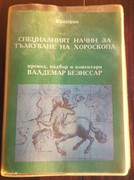
I confirm what I have written and translated about the book in Bulgarian. Here is the full information:
Book title and author in Bulgarian: "Специални??т начин за тълкуване на хоро??копа
превод, подбор и коментари Валдемар Бези????ар", издадена през 1993г от издател??тво ??ратрон
Translation: "The Special Way of Interpreting the Horoscope
translation, selection and commentary Valdemar Bezissar", published in 1993 by Aratron publishing house.
The bulk of the book is a treatise by Arabic astrologer Andrusar Ibn Zabi Al Farukh aka Doronius. James Herschel Holden’s Biographical Dictionary of Western Astrologers says on p.32 that Levy identified Andrusar Ibn Zabi Al Farukh as Andruzagar inb Zabi Al Farrrukh, but according to David Pingree this is Zadhan Farrukh al-Andarzaghar.
The translator of the book, Valdemar Bezissar aka Fiodor Gruzinev, writes on the very first paragraph of the book (page 13) that the treatise was found by Heinrich Rantzau, count of Schleswig-Holstein. Then the book begins with what I translated above and which I also here confirm its verasity. The year given is 1547.