USA Election 2020: KP and Return Chart Choices
Posted: Mon Nov 02, 2020 7:06 pm
USA Election 2020: KP and Return Chart Choices
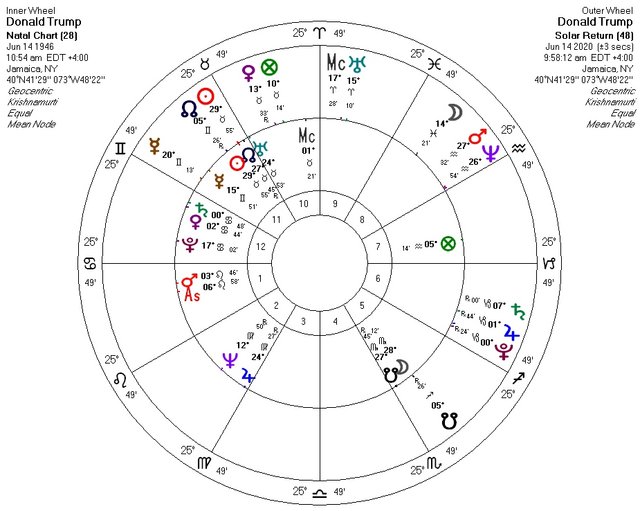
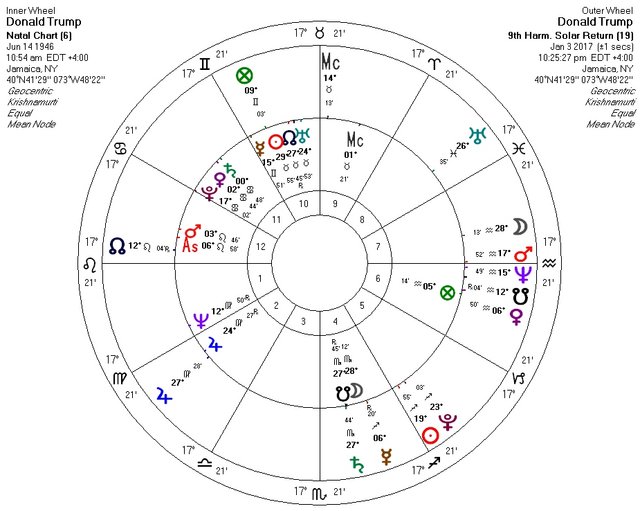
I am both amused and astounded at the variety of techniques used by astrologers in attempting to predict the outcome of the 2020 American election. A science astrology is not, at least in its current state near the beginning of the 21st century. As I’m not a mundane or predictive astrologer, I thought rather than adding one more “guess??? to the mix, it would be interesting to look at return charts and note the interpretation choices astrologers would have in attempting a prediction. Others are welcome to comment on these charts.
Due to the uncertainty of this year’s U.S. election, I’ve been looking at the inaugural date rather than the projected election date of November 3, 2020. At the very least a delayed vote count is expected due to the large number of mail-in ballots. So there is significant doubt that we will have final election results on the day following the election.
My personal research approach at this time involves combining solar returns (annual charts) and enneads (40 day subdivisions of the solar return) with KP (Krishnamurti Padhdhati) techniques which place priority on the lunar mansions (termed “stars??? in this system because each mansion contains specific stars).
We cannot tell what a planetary transit might mean or in what area of life it might manifest without some way to qualify it. The KP system discovered by K. S. Krishnamurti in the last century uses a unique system of zodiacal degrees as used in Vimshotari Dasas assigned to various planets. Each lunar mansion (nakshatra) of 13 degrees, 20 minutes contains 9 sub-periods and 81 sub-sub (sub-2) periods.
These small planetary degree and micro minute areas (which can be as small as two astrological minutes) link directly to the natal chart via house rulerships and house positions as I describe in this post. The primary principle of the KP system is that lunar mansion (“star??? or nakshatra) lords describe how a planet’s energies will manifest. Though many astrologers successfully use the KP system, as a unique 20th century innovation, it is still in the stage of being tested. However, these charts can be read using more standard interpretation techniques.
I use the Krishnamurti ayanamsa and follow the same chart design for all charts: Equal houses measured from the ascendant with the ascendant degree in all houses marking the center of the houses. Any planet that is close to a center (ascendant) degree will have special importance in the chart, particularly in return charts. (But for those interested, the MC degree may also be used for 10th house emphasis.) After some experimentation I am setting all return charts for the location of birth rather than changing the location to residence. In India the birth location is always used for annual charts.
(Continued in next post)
I am both amused and astounded at the variety of techniques used by astrologers in attempting to predict the outcome of the 2020 American election. A science astrology is not, at least in its current state near the beginning of the 21st century. As I’m not a mundane or predictive astrologer, I thought rather than adding one more “guess??? to the mix, it would be interesting to look at return charts and note the interpretation choices astrologers would have in attempting a prediction. Others are welcome to comment on these charts.
Due to the uncertainty of this year’s U.S. election, I’ve been looking at the inaugural date rather than the projected election date of November 3, 2020. At the very least a delayed vote count is expected due to the large number of mail-in ballots. So there is significant doubt that we will have final election results on the day following the election.
My personal research approach at this time involves combining solar returns (annual charts) and enneads (40 day subdivisions of the solar return) with KP (Krishnamurti Padhdhati) techniques which place priority on the lunar mansions (termed “stars??? in this system because each mansion contains specific stars).
We cannot tell what a planetary transit might mean or in what area of life it might manifest without some way to qualify it. The KP system discovered by K. S. Krishnamurti in the last century uses a unique system of zodiacal degrees as used in Vimshotari Dasas assigned to various planets. Each lunar mansion (nakshatra) of 13 degrees, 20 minutes contains 9 sub-periods and 81 sub-sub (sub-2) periods.
These small planetary degree and micro minute areas (which can be as small as two astrological minutes) link directly to the natal chart via house rulerships and house positions as I describe in this post. The primary principle of the KP system is that lunar mansion (“star??? or nakshatra) lords describe how a planet’s energies will manifest. Though many astrologers successfully use the KP system, as a unique 20th century innovation, it is still in the stage of being tested. However, these charts can be read using more standard interpretation techniques.
I use the Krishnamurti ayanamsa and follow the same chart design for all charts: Equal houses measured from the ascendant with the ascendant degree in all houses marking the center of the houses. Any planet that is close to a center (ascendant) degree will have special importance in the chart, particularly in return charts. (But for those interested, the MC degree may also be used for 10th house emphasis.) After some experimentation I am setting all return charts for the location of birth rather than changing the location to residence. In India the birth location is always used for annual charts.
(Continued in next post)