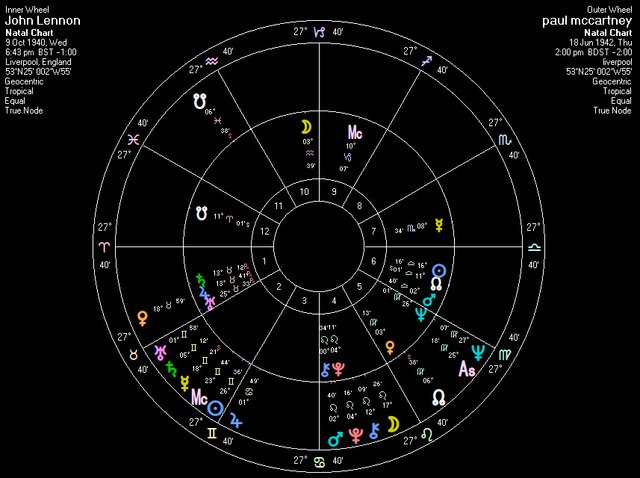
Synastry placements by Dorotheus
Posted: Thu Jan 07, 2021 2:04 am
Synastry is thought to be a relatively new field, and not everybody believes in the modern way of doing it. John Frawley in his book The Real Astrology, Chapter 15, went as far as saying that planetary contacts are trivial and superficial. The secret of real synastry, Frawley said, lies in individual temperament as depicted in the partners' natal charts. Is it hot, dry, wet, or cold? Is it watery, earthy, fiery, or airy? What are they missing? What do they need? Only from there we can work out love and suitability.
But "superficial" comparison of aspects apparently goes back to ancient times, although the discussion tended to be scattered, and certainly wasn't as systematic, lengthy and sometimes tedious as what we have today. I feel like contemporary synastry pays so much attention to modern planets and fancy points we risk sidestepping, if not losing altogether, the older gems of wisdom.
I've been indexing as I read ancient and medieval astrologers, and I'd like to share what I found about synastry in Dorotheus' work with you, in case it is of interest. Maybe if I got lucky, some of you would even enlighten me on your experience with these placements.
The below are taken from Dorotheus of Sidon, 1st centuary AD., CARMEN ASTROLOGICUM, trans. David Pingree. Book 2, Chapter 5 & Book 5, Chapter 16.
Placements that indicate suitability
Same-sign ascendants
Sun in the other's Midheaven
Sun in the other's ASC
Moon in the other's Midheaven
Moon in the other's ASC
One's Moon the sign of the other's Venus, especially when the two Moons are in trine
One's Venus or Jupiter the sign of the other's Venus or Jupiter
If one's Moon happens to be in the sign of that happens to be in the other's house of misery [the sixth]:
Dorotheus of Sidon, who appears to have lived in Alexandria, flourished in the first century AD. He wrote his Pentateuch (five books) on astrology in Greek, in verse... Written a century before Ptolemy, here is the mainstream of Greek astrology. It will handsomely repay study.
But "superficial" comparison of aspects apparently goes back to ancient times, although the discussion tended to be scattered, and certainly wasn't as systematic, lengthy and sometimes tedious as what we have today. I feel like contemporary synastry pays so much attention to modern planets and fancy points we risk sidestepping, if not losing altogether, the older gems of wisdom.
I've been indexing as I read ancient and medieval astrologers, and I'd like to share what I found about synastry in Dorotheus' work with you, in case it is of interest. Maybe if I got lucky, some of you would even enlighten me on your experience with these placements.
The below are taken from Dorotheus of Sidon, 1st centuary AD., CARMEN ASTROLOGICUM, trans. David Pingree. Book 2, Chapter 5 & Book 5, Chapter 16.
Placements that indicate suitability
Same-sign ascendants
Sun in the other's Midheaven
Sun in the other's ASC
Moon in the other's Midheaven
Moon in the other's ASC
One's Moon the sign of the other's Venus, especially when the two Moons are in trine
One's Venus or Jupiter the sign of the other's Venus or Jupiter
Placements that indicate injury, argument and mismatch:It is thus if, in the nativities of two men or of two women, a star from among the benefics is in the same sign as it indicates that there will be brotherhood and love and agreement between the two.
Edit to add:But if, wherever one luminary of one of the two [marriage partners] is, in this sign there is a malefic for the other, then it indicates injury and little agreement, but if, wherever a luminary of one of the two is, in it there is a benefic for the other, or all the benefics of the two natives are in cardines, or the lot of both of them is in the same sign, it indicates agreement and suitability.
If one's Moon happens to be in the sign of that happens to be in the other's house of misery [the sixth]:
Bio from Amazon:It indicates that he whose Moon happens to be in the house of misery of his companion will subjugate his companion and tower over him until his companion becomes obedient, [and] it is like the obedience of a slave to his master.
Dorotheus of Sidon, who appears to have lived in Alexandria, flourished in the first century AD. He wrote his Pentateuch (five books) on astrology in Greek, in verse... Written a century before Ptolemy, here is the mainstream of Greek astrology. It will handsomely repay study.