Posted: Tue Dec 21, 2021 12:36 pm
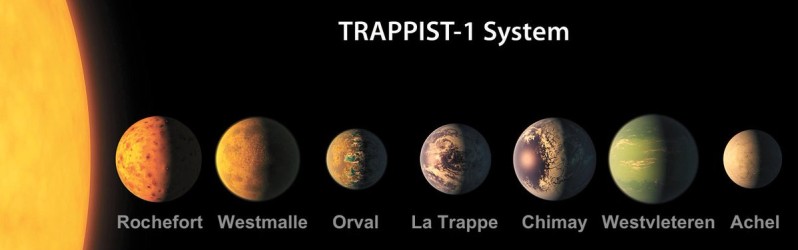
Today, in a far, far distant solar system, seven exoplanets orbit a "red dwarf."
Three of these exoplanets are close enough to their star that liquid water is present. And one of them, "Trappist-1 f", has the right density as well.
But first of all, "Webb" must be put into orbit. After its launch, scheduled for Friday from Kourou, French Guiana - the European Space Agency is also a partner - the telescope is to deploy into space from the hold of an Ariane 5 rocket, like a gigantic remote-controlled origami.
That "Webb" is NASA's James-Webb Space Telescope, the product of more than twenty years of work, and $ 13 billion in investments, which should finally launch this week...
The Webb, equipped with two essential systems is the successor to the famous “Hubble??? space telescope. But Webb will orbit much deeper in space - about 1.6 million kilometers from Earth, well beyond the Moon. The new telescope will also be 100 to a million times more sensitive than Hubble.
Webb is designed to unravel two great mysteries of the universe: the nature of the planets beyond our solar system, and what the oldest galaxies can teach us about the birth of the universe. Webb will be able to analyze the atmosphere of exoplanets and collect data on galaxies where the "first lights" appeared 13.6 billion years ago.
The essential tools for this work: a fine guiding sensor, which allows the telescope to be surgically pointed towards the outer reaches of the universe, and a "near infrared imager and slitless spectrograph", which helps analyze light. observed by the telescope...
In addition to exoplanets and "early light" galaxies, Canadian researchers will use Webb to study, for example, asteroids and comets near Earth, or how stars affect the space around them in the far reaches of the galaxy. where new suns are born.
The Earth should receive images by June that could stun the world, as did in 1990 the first images captured and transmitted by Hubble.
The exoplanet Trappist-1 f seems to be a perfect (solar) system. These exoplanets will be the main targets of Webb.
Adapted and translated from Bob Weber, The Canadian Press
https://www.lapresse.ca/actualites/scie ... z-nous.php
Three of these exoplanets are close enough to their star that liquid water is present. And one of them, "Trappist-1 f", has the right density as well.
But first of all, "Webb" must be put into orbit. After its launch, scheduled for Friday from Kourou, French Guiana - the European Space Agency is also a partner - the telescope is to deploy into space from the hold of an Ariane 5 rocket, like a gigantic remote-controlled origami.
That "Webb" is NASA's James-Webb Space Telescope, the product of more than twenty years of work, and $ 13 billion in investments, which should finally launch this week...
The Webb, equipped with two essential systems is the successor to the famous “Hubble??? space telescope. But Webb will orbit much deeper in space - about 1.6 million kilometers from Earth, well beyond the Moon. The new telescope will also be 100 to a million times more sensitive than Hubble.
Webb is designed to unravel two great mysteries of the universe: the nature of the planets beyond our solar system, and what the oldest galaxies can teach us about the birth of the universe. Webb will be able to analyze the atmosphere of exoplanets and collect data on galaxies where the "first lights" appeared 13.6 billion years ago.
The essential tools for this work: a fine guiding sensor, which allows the telescope to be surgically pointed towards the outer reaches of the universe, and a "near infrared imager and slitless spectrograph", which helps analyze light. observed by the telescope...
In addition to exoplanets and "early light" galaxies, Canadian researchers will use Webb to study, for example, asteroids and comets near Earth, or how stars affect the space around them in the far reaches of the galaxy. where new suns are born.
The Earth should receive images by June that could stun the world, as did in 1990 the first images captured and transmitted by Hubble.
The exoplanet Trappist-1 f seems to be a perfect (solar) system. These exoplanets will be the main targets of Webb.
Adapted and translated from Bob Weber, The Canadian Press
https://www.lapresse.ca/actualites/scie ... z-nous.php

 ) people will be born on other planets in our solar system, and eventually in other star systems altogether! These exoplanets should each have their own astrological meanings, just as our own solar system's planets have meanings. I predict exoplanets will become an important part of astrology in the years and centuries to come.