Page 1 of 1

About friendship between husband and wife (Gaurico, 1539)

Posted: Fri Oct 03, 2008 7:16 pm
by margherita
I've just finished to upload in my blog a new translation of mine about marriage and sinastry from Luca Gaurico's "Trattato d'astrologia giudiziaria" (1539).


Downloads of "About friendship between husband and wife" from Widget box, left columm of my blog:

http://www.heavenastrolabe.splinder.com/
Image

Posted: Fri Oct 03, 2008 8:03 pm
by yuzuru
Hi, thanks for that, seens interessant.


But I am having a little problem. I don?t seen to have the apropriate fonts in Adobe Reader, or you may have made an error, I don?t know.

For example, in the beginning of the book I read this:

"B and D are the wife; the B in one of the four oriental houses signifies he will marry in his youth, or old he will marry a young girl."

It is easy to see that B is the moon... but you know if I can solve the problem ?

Posted: Sat Oct 04, 2008 7:50 am
by margherita
It is easy to see that B is the moon... but you know if I can solve the problem ?
I'm sorry, I forgot to embed astro fonts.
I have just uploaded a new file. If it does not work, please let me know.

Posted: Sat Oct 04, 2008 8:52 am
by Deb
Thank you for making this work available. There is very little from Cardano that has been translated into English so this is precious. I had the same problem as Yuzuru but the fonts are fine now. However, I still have a problem in being unable to print because the background shading creates a series of dots that clash with the text. I'm not sure if this is a problem that is peculiar to me, or whether other people will experience this too.

In any event, thanks again for your generosity.

Deb

Posted: Sat Oct 04, 2008 11:13 am
by margherita
Thank you for making this work available. There is very little from Cardano that has been translated into English so this is precious.
Hello Deborah,
this is not Cardano, is Luca Gaurico, his worst enemy. they spent all their life quarrelling as old spinsters :D

I had the same problem as Yuzuru but the fonts are fine now. However, I still have a problem in being unable to print because the background shading creates a series of dots that clash with the text. I'm not sure if this is a problem that is peculiar to me, or whether other people will experience this too.
I'm sorry of so many problems,
It is because the original text has astro fonts too, so I desired to preserve them.

Anyway, I added at the same address:

http://www.heavenastrolabe.splinder.com/

another file called "print_about friendship between husband and wife" without any background.
I hope it is better now,

Posted: Sat Oct 04, 2008 11:41 am
by Deb
I meant Gaurico, but my brain and typing fingers are getting more and more disassociated lately. Not to make you feel stressed or anything, but we need more translations from both of those authors!

Thank you for being so accommodating. I'd like to refer to a couple of points in this tract in one of my course lessons, and recommend my students to it. Is it OK to do that, and if so, is the download link likely to be permanent? This is very useful, especially as I also try to stress the importance of helical phasing; since it is such a fundamental basis to understanding planetary signification.

(BTW, I love the reference to the Moon beholding Venus as describing a wife who is 'plumpy, beautiful, happy and pleasant'. 'Plumpy' is such a good word for Venus :) )

Posted: Sun Oct 05, 2008 5:14 am
by Papretis
Gjiada wrote:Anyway, I added at the same address:

http://www.heavenastrolabe.splinder.com/

another file called "print_about friendship between husband and wife" without any background.
I hope it is better now,
I was too bothered about the black spots, but now the file prints finely. Thank you Gjiada for sharing these translations! This one looks especially interesting.

Posted: Sun Oct 05, 2008 6:55 am
by margherita
Not to make you feel stressed or anything, but we need more translations from both of those authors!
Hello Deborah,
it could be ok.
At the moment I'm revising my translation of Albumasar's Liber VI about paranatellonta rising with 36 decans.
But with another astrologer we are starting "De Stella Nova" project, and we are thinking about other Renaissance translations.
I hope both very soon.

I'd like to refer to a couple of points in this tract in one of my course lessons, and recommend my students to it. Is it OK to do that, and if so, is the download link likely to be permanent?
I'm very pleased and honoured.
And at the moment no desire to move files in another place.
This is very useful, especially as I also try to stress the importance of helical phasing; since it is such a fundamental basis to understanding planetary signification
It's because Ptolemy gives a lot of importance to the heliacal phase; planets took their qualities and meaning from their position in respect with the Sun (I should say in a different way from Lilly, not just if a planet is oriental or occidental).

So for example in the case of sex, Venus when it is invisible gives feminine instincts in feminine signs snd masculine when in masculine signs.
But when she is in her vespertine rising gives the greatest feminine quality. From the first station to the retrograde synod she gives the lower feminine quality. At the retrograde synod is like the upper conjunction, then from the synod to the second station signifies the lower male quality, which is increasesing more and more when Venus turns direct.

Anyway Gaurico is more easy to read than Ptolemy, he was always direct in his speech.
Posted: Sun Oct 05, 2008 7:05 am
by margherita
Papretis wrote: Thank you Gjiada for sharing these translations! This one looks especially interesting.
Hello,
well, paranatellonta are a different approach to astrology than Ptolemaic one.

If for Ptolemy qualities of signs depend on the four qualities, for Manilius and Firmicus qualities of signs depend on the stars rising with the Ascendant.

In small words, Virgo signifies religious things because of Spica rising with the sign, not because it is a cold and dry sign or the Sun has a peculiar place on the ecliptic.
And it was a common and widespread idea that decans ruled men destiny in hermetic philosophy.

I find both methods work in my experience. Anyway stars are not easy to deal with, I agree.

Posted: Fri Oct 10, 2008 1:04 pm
by Mark
Hello Margherita,

I thought I had replied on this thread but I must have forgot. You really are becoming a one woman production company. And its all free! Thank you again.
If for Ptolemy qualities of signs depend on the four qualities, for Manilius and Firmicus qualities of signs depend on the stars rising with the Ascendant.

A very interesting reflection. To what extent do you think these astrologers used in mundo positions of the stars? The medieval and renaissance astrologers relied heavily on zodiacal projection but this seems a long way from the more visual astrology of the hellenistic tradition.

Mark

Posted: Sat Oct 11, 2008 9:38 am
by margherita
MarkC wrote:Hello Margherita,
A very interesting reflection. To what extent do you think these astrologers used in mundo positions of the stars? The medieval and renaissance astrologers relied heavily on zodiacal projection but this seems a long way from the more visual astrology of the hellenistic tradition.
Hello Mark,
I think you are right, it's very difficult to understand what medieval and Renaissance authors do with stars, at least for me.

As you know, Manilius was lost and rediscovered in 1417 and soon printed in 1473, so many astrologers took stars just as they found in the new book.

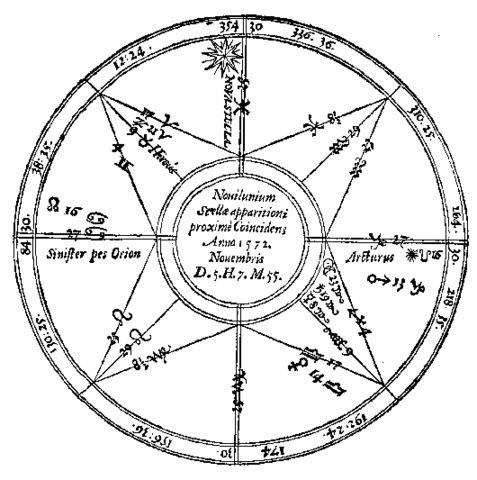
Anyway I found an example of "in mundo" position in Tycho Brahe. In his book De nova Stella (1575) he gives some astrological predictions for the supernova he saw in the sky near Cassiopea.
In the book he cast the chart for the preceding syzygy:
Image
The new star has a longitude of 12 Taurus (a friend helped me with formula ) but as you see, the star is in Aries (Brahe told this too) according its RA- it is culminating.

What this means you will know soon, or so I hope :)

Have a nice day,
margherita

visit me at www.heavenastrolabe.splinder.com