Hi Steve,
Please don't let my views spoil your enthusiasm and your desire for research. I simply don't think we should use transits to relocated charts. Perhaps this rather a more (personal) 'ethics' motivated view from my side than one based upon investigation. If Hand says that:"You could utterly alter the scenario of a year's transits by going from New York to London!", I believe one might easily interprete this in the sense of changing ones 'fate'. Perhaps he's right but I wouldn't feel comfortable with it. I'm afraid it could make people litterally 'run away' for their problematic transits.
This doesn't need to bother the calculations though. You can experiment with the method with those Astrodienst charts of my post of yesterday. It looks difficult but you don't have to do calculations, the worst thing is that it's probably a bit time consuming.
Addition 21:00
Here are some formulae which can be performed with a pocket calculator.
First the angle between ecliptic and horizon has to be calculated. with
-cos d * sin a * sin e + sin d * cos e = sin l
, the distance from zenith to the ecliptic is measured. d=declination, a=sidereal time expressed in degrees, e=obliquity of the ecliptic (to the equator) and l=the latitude of the zenithpoint. 90?-l=highest point of the ecliptic. At the same time this is thus the angle between ecliptic and horizon.
With the following formulae the distance of the point, where the planet will touch the horizon, to the ascendant will be found.
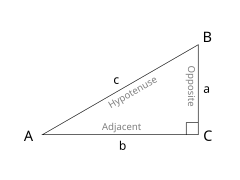
These formulae (based upon John Napier's rules) are for spherical triangles with one right angle/90?, C. A and B are the other angles. In these calculations the triangle is to be seen with A the angle between ecliptic and horizon (result 'l' from the formula above). a (not to be confused with the 'a' of the formula above) is the angle of the side in the trine opposite of A (and thus adjacent to angles B and C), b is opposite angle B and c opposite C. A is the point of the ascendant, B is the point on the ecliptic that is related to the planet C, is the point on the horizon and is the point of the body of the planet.
sin a = sin A * sin c
a=the latitude of the planet (many ephemerides don't give the latitude of planets but
www.ephemeris.com does). With a and A as known we can calculate c. c=is the side of the triangle that coincides with the horizon, the distance of C to A. This is further not of our interest but leads us to the following formula.
cos c = cos a * cos b
With a and c as known we get b. This is our desired distance of the ecliptical position of the planet (while at the same time we saw the body of the planet touches the horizon at C). Depending on the latitude being positive or negative, b is subtracted respectively added to the position of A which is the ecliptical position of the ascendant.
This is all difficult to understand using just the formulae. To see what is happening one should make a drawing of the particular situation and find the right angled triangle back in the picture and then apply the formula. Often in many cases I do this myself, or I try to imagine this in the mind, it's really helpfull. This is what the basis triangle ABC looks like.
http://upload.wikimedia.org/wikipedia/c ... le.svg.png You can lead almost every mathematical issue in astrology to this triangle.
Please take a look at this picture:
http://www.math.cornell.edu/~mec/larges ... iangle.jpg
It looks like we would see the globe (from the outside) and on the West-side of the horizon (on the Northern hemisphere in the temperate zone). Here the sides of the triangle are named: l, ll and lll. If we would call the angles opposite of these sides i, ii and iii respectively, then 'l' coincides with the horizon, 'll' is the line from planetary body to the ecliptic and 'lll' coincides with the ecliptic. 'i' coincides with the point on the ecliptic where the ephemeris places the planet ecliptically, 'i' is also the 90? angle, 'ii' coincides with the point on the ecliptic and is the resulting angle size of the very first formula here, 'iii' coincides with the body of the planet, and is on the horizon. In this picture the latitude of the planet would be negative even though the ecliptical point of the planet crossed the ascendant a while ago, now the planet would be just on the horizon.
There's one interesting issue. Since most latitudes of planets are relatively small and in case the ecliptic to horizon is not extremely small (which sometimes occur in polar regions), we can work with
congruence. Congruence is a concept in plane geometry (and thus also plane trigonometry), when there are two triangles and the angles of the first triangle is of the same size as the other but the length of one of the sides of the first triangle is twice that of the second, the other angles too will be twice the size of the sides of the other triangle.
This picture illustrates this:
http://hotmath.com/images/gt/lessons/ge ... angles.gif
With the small triangle in the big one we get something that looks like this:
http://www.apronus.com/geometry/images/4sides.gif
Ignore the line AC, our interest is the big triangle DAE and the smaller one CBE within the big one. (in this picture A and B aren't 90? but close to it).
So the only thing we have to do, when dealing with normal sizes, after calculating one example, we use the proportions of a and b in the second and third formula of the post. When we look at the latitudes in the ephemeris, which changes during the movement of the planet we apply the proportion formula to estimate the date the body of the planet will touch the horizon. Then the calculations can be done for more exactness.
Again note that the use of congruence isn't totally correct for spherical triangles. This example will illustrate this. Latitude on Earth 51.5?N (London area) sidereal time 18:00. This is the easiest example since the equinoctical points coincide with East and West and 0?Capricorn is in the meridian and the highest point at the same time. For an obliquity of the ecliptic of 23.5? the height is 15?. Descendant is 0?Libra. If we look for a planet transiting the western horizion a planet with latitude
+1? will require a subtraction of 3?44' from the Descendant,
+2? 7?29'
+5? 19?03'
+8? 31?38'
+12? 52?30'
+15? 90?
If sidereal time is 6:00, 0?Cancer is in the meridian and coincides with the highest point of the ecliptic, height will be 62?. For the same latitudes and planet's transiting the western horizon (Asc. = 0?Aries) the results to be subtracted from the ascendant value will be:
+1? 0?32'
+2? 1?04'
+5? 2?40?
+8? 4?17'
+12? 6?29'
+15? 8?11'
Now if the latitudes are compared it becomes visible that the use of congruence won't lead to extreme differences unless at a small angle of ecliptic-horizon (the first serie) and/or high latitudes of planets.
So for people who haven't yet thrown their computer out of the window after reading all this, it illustrates how with relatively few formulae the calculations can be made, and that Robert Hand is right in saying that the computer program for it would be easy. Perhaps it's the combination with an electronical ephemeris program that would make it difficult or unattractive for program developers. Maybe someone who understands programs a bit can make a program with the basis formulae in which one self has to fill in the planetary positions longitude and latitude.
 ) and I have not done ANY programming for the PC. (My programming was all in Modula2 on the Amiga graphics workstation, many moons ago...yeah, an old fart am I)