Outer Planets and the Zodiac
Posted: Wed Feb 19, 2014 6:40 am
Outer Planets and the Zodiac: Part 1
For a long time I?ve seen the solar/lunar halves of the zodiac as the key to outer planet affinities. though this division has fallen into disuse in modern times. This division of the zodiac is known in both East and West, and is mentioned in several texts including Ptolemy?s Tetrabiblos.
In his discussion of signs of the zodiac, Johannes Schoener calls the diurnal or day signs of the zodiac the planets's principal signs while the night signs are termed secondary. (Opusculum Astrologicum, Golden Hind Press, 1994) Bonatti terms these zodiac halves "greater" or "lesser" which he relates to ascension times, but says, "And [the lesser] is called the half of the Moon, because the Moon has such virtue in that whole half..." (Bonatti on Basic Astrology, Cazimi Press, 2010, p.49)
Perhaps the most intriguing view of the relationship between the planetary gods and signs is suggested by a note on sign-planetary affinities first published in 1995 by Project Hindsight in the booklet The Astrological Record of the Early Sages in Greek. A text fragment, supposedly of ancient Persian Zoroastrian origins assigns planets as the co-inhabitants of signs of the zodiac. If this fragment does indeed come from an ancient Persian source, it indicates that the Zoroastrian priests apparently had a grasp of signs that could only be called contemporary.
And concerning zodiacal habitation, they say that it is divided into six domiciles in the following fashion: the domiciles of Kronos [Saturn] are Capricorn and Aquarius; of Zeus [Jupiter], Sagittarius and Pisces; of Ares [Mars], Scorpio and Aries; of Aphrodite [Venus], Libra and Taurus; of Hermes [Mercury], Virgo and Gemini; of the Sun, Leo and Cancer. The co-inhabitants of these... (Leo through Capricorn deleted for brevity)
It is the co-inhabitants of the lunar half of the zodiac that is of interest when considering the outers. From the text:
Aquarius: Artemis [who lived remote from mankind on mountain tops and forests] with Kronos
(Artemis is not Uranus, but she shares the planet's quality of remoteness and individuality.)
Pisces: Poseidon [Neptune] with Zeus
Aries: Pluto with Ares
Taurus: Imeros [god of desire] with Aphrodite
Gemini: Nephele [a phantom-like woman] with Hermes
(CCAG 8, 3; 120-122, page 23 of The Astrological Record of the Early Sages in Greek, (translated by Robert Schmidt, edited by Robert Hand) Project Hindsight, 1995)
Robert Schmidt (Phasewatch, 1997) has suggested that the co-inhabitants of each sign may be meant to bring out how the planet behaves in its different domiciles, so that Aphrodite may be mutual love in Libra [or the responsibility of marriage, Libra being Saturn's exaltation sign], but desire in Taurus, a more bohemian placement. It's also possible that the co-inhabitants describe some characteristics of the signs themselves.
A Possible Philosophical Foundation for the Discovery of Uranus, Neptune and Pluto:
These two divisions were sometimes referred to as day and night halves of the zodiac. Before the discovery of the trans-Saturnian planets and the psychology of the individual, the needs of society as a whole tended to be paramount. The ancient solar half of the zodiac (Leo through Capricorn) represented social roles and one's duty to society. (The Sun shines during the day when most of the work of society is done.) The lunar half of the zodiac (Cancer backwards through Aquarius) may represent personal or individual growth without concern for the demands and obligations of society.
Before contemporary times the masses (represented by the Moon) were considered as a group with little or no attention being given to individual differences and personal needs. Astrology understands the Moon as symbolizing consciousness. I haven?t studied what has been called "evolutionary astrology," but at least in metaphysical circles it's believed that we are on the threshold of a leap in human consciousness.
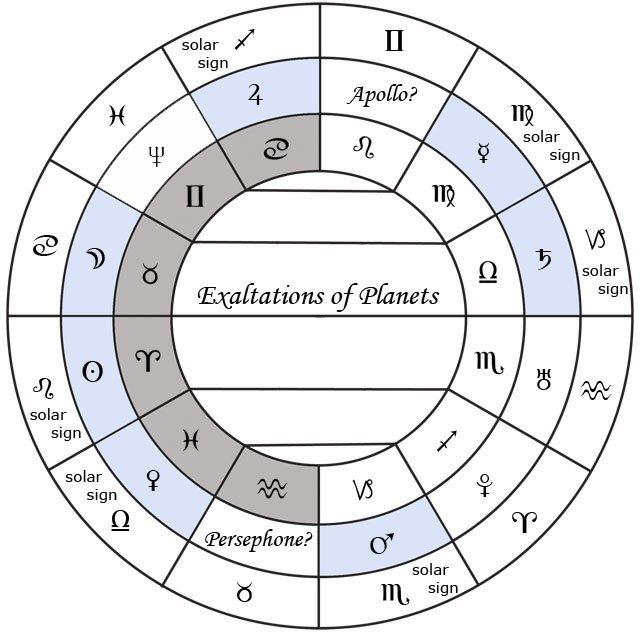
The current world chaos is seen as a reflection of the clash of the old world view in conflict with the new in-coming energies. I suspect that many astrologers would link these coming changes to the three outer planets beyond Saturn. I believe (based on the diagram in part 2) that there is some validity to that connection.
Thus, we might say that in relationship to planetary affinity, the lunar side of the zodiac in a general way symbolizes developing human consciousness, new avenues of inner awareness that were only in seed form in prior centuries. The discipline of psychology is the most obvious testimony of concern for the individual rather than emphasis on the masses as a group, the old solar way.
(Part 2: continued in next post)
For a long time I?ve seen the solar/lunar halves of the zodiac as the key to outer planet affinities. though this division has fallen into disuse in modern times. This division of the zodiac is known in both East and West, and is mentioned in several texts including Ptolemy?s Tetrabiblos.
In his discussion of signs of the zodiac, Johannes Schoener calls the diurnal or day signs of the zodiac the planets's principal signs while the night signs are termed secondary. (Opusculum Astrologicum, Golden Hind Press, 1994) Bonatti terms these zodiac halves "greater" or "lesser" which he relates to ascension times, but says, "And [the lesser] is called the half of the Moon, because the Moon has such virtue in that whole half..." (Bonatti on Basic Astrology, Cazimi Press, 2010, p.49)
Perhaps the most intriguing view of the relationship between the planetary gods and signs is suggested by a note on sign-planetary affinities first published in 1995 by Project Hindsight in the booklet The Astrological Record of the Early Sages in Greek. A text fragment, supposedly of ancient Persian Zoroastrian origins assigns planets as the co-inhabitants of signs of the zodiac. If this fragment does indeed come from an ancient Persian source, it indicates that the Zoroastrian priests apparently had a grasp of signs that could only be called contemporary.
And concerning zodiacal habitation, they say that it is divided into six domiciles in the following fashion: the domiciles of Kronos [Saturn] are Capricorn and Aquarius; of Zeus [Jupiter], Sagittarius and Pisces; of Ares [Mars], Scorpio and Aries; of Aphrodite [Venus], Libra and Taurus; of Hermes [Mercury], Virgo and Gemini; of the Sun, Leo and Cancer. The co-inhabitants of these... (Leo through Capricorn deleted for brevity)
It is the co-inhabitants of the lunar half of the zodiac that is of interest when considering the outers. From the text:
Aquarius: Artemis [who lived remote from mankind on mountain tops and forests] with Kronos
(Artemis is not Uranus, but she shares the planet's quality of remoteness and individuality.)
Pisces: Poseidon [Neptune] with Zeus
Aries: Pluto with Ares
Taurus: Imeros [god of desire] with Aphrodite
Gemini: Nephele [a phantom-like woman] with Hermes
(CCAG 8, 3; 120-122, page 23 of The Astrological Record of the Early Sages in Greek, (translated by Robert Schmidt, edited by Robert Hand) Project Hindsight, 1995)
Robert Schmidt (Phasewatch, 1997) has suggested that the co-inhabitants of each sign may be meant to bring out how the planet behaves in its different domiciles, so that Aphrodite may be mutual love in Libra [or the responsibility of marriage, Libra being Saturn's exaltation sign], but desire in Taurus, a more bohemian placement. It's also possible that the co-inhabitants describe some characteristics of the signs themselves.
A Possible Philosophical Foundation for the Discovery of Uranus, Neptune and Pluto:
These two divisions were sometimes referred to as day and night halves of the zodiac. Before the discovery of the trans-Saturnian planets and the psychology of the individual, the needs of society as a whole tended to be paramount. The ancient solar half of the zodiac (Leo through Capricorn) represented social roles and one's duty to society. (The Sun shines during the day when most of the work of society is done.) The lunar half of the zodiac (Cancer backwards through Aquarius) may represent personal or individual growth without concern for the demands and obligations of society.
Before contemporary times the masses (represented by the Moon) were considered as a group with little or no attention being given to individual differences and personal needs. Astrology understands the Moon as symbolizing consciousness. I haven?t studied what has been called "evolutionary astrology," but at least in metaphysical circles it's believed that we are on the threshold of a leap in human consciousness.
The current world chaos is seen as a reflection of the clash of the old world view in conflict with the new in-coming energies. I suspect that many astrologers would link these coming changes to the three outer planets beyond Saturn. I believe (based on the diagram in part 2) that there is some validity to that connection.
Thus, we might say that in relationship to planetary affinity, the lunar side of the zodiac in a general way symbolizes developing human consciousness, new avenues of inner awareness that were only in seed form in prior centuries. The discipline of psychology is the most obvious testimony of concern for the individual rather than emphasis on the masses as a group, the old solar way.
(Part 2: continued in next post)